
Proteins
A complete guide to types, doses and what each one is for
GYM
Dr. Ixchel Corcuera — Family and Emergency Medicine
7/10/20266 min read
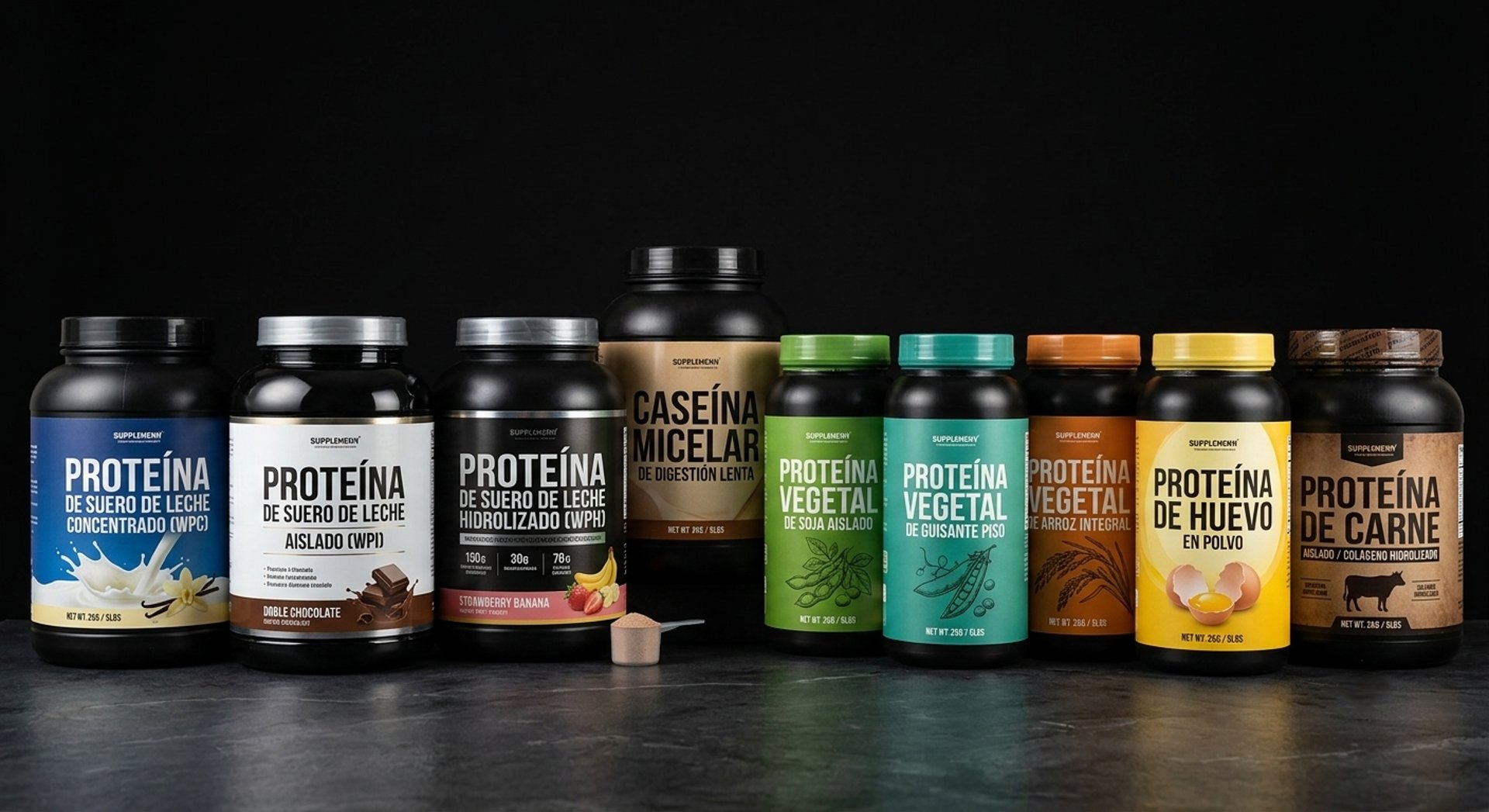
Of all the nutrition topics that come up in my practice, protein is probably the one that generates the most confusion. Some believe you have to take enormous amounts to build muscle, others fear it damages the kidneys, and almost nobody really knows how much they need or which type suits them. Let's sort it out.
Protein isn't just a gym thing. It's one of the three essential macronutrients, the material the body uses to build and repair practically everything: muscle, skin, hair, nails, enzymes, hormones, antibodies. We can't live without it, and a significant part of the population, especially past a certain age, doesn't get enough. This article explains how much you need, what types exist and what each one really provides.
What protein is and why it matters so much
Proteins are made of amino acids, molecules that work like the pieces of a construction set. There are twenty amino acids, and nine of them are essential: the body can't produce them, so they have to come from the diet. The quality of a protein depends precisely on how many of these essential amino acids it provides and in what proportion.
When you eat protein, the body breaks it down into its amino acids and then reassembles them according to what it needs at that moment: repairing a muscle fibre damaged by training, making a digestive enzyme, producing an antibody. That continuous process of breakdown and rebuilding is called protein turnover, and it never stops. That's why we need a constant supply.
A key concept is leucine, one of the essential amino acids. Leucine acts as the switch that activates muscle protein synthesis. Proteins rich in leucine are therefore especially effective for building and maintaining muscle.
How much protein you need according to your weight
This is the question I'm asked most, and the answer depends on your situation. Here are the reference figures per kilogram of bodyweight per day, which is how it's correctly calculated.
Sedentary person: between 0.8 and 1 gram per kilo per day. It's the minimum to maintain the body's basic functions. For someone of 70 kg, that's about 56 to 70 grams daily.
Active person or strength trainer: between 1.4 and 2 grams per kilo per day. This is the range the International Society of Sports Nutrition recommends to optimise training adaptations. For that same 70 kg person, it would be between 98 and 140 grams daily.
In a cutting or fat-loss phase: it can go up to 2 or 2.4 grams per kilo. When calorie intake is reduced, increasing protein helps preserve muscle mass while losing fat, and it's also more satiating.
Older person: here there's an important clinical nuance. From age 65, the body responds worse to the protein stimulus, a phenomenon called anabolic resistance. That's why in older people it's advisable to raise the intake to 1.2 or even 1.5 grams per kilo, provided kidney function allows, to slow the age-related loss of muscle mass, the dreaded sarcopenia.
An important note on distribution: it doesn't help much to concentrate all your protein in a single meal. The body makes better use of protein spread throughout the day, in servings of between 20 and 40 grams, which is the amount that maximises muscle synthesis at each meal.
The types of protein powder
Although the best source of protein will always be real food, powdered supplements are a convenient tool for reaching daily targets. These are the main types.
Whey protein
It's the most popular and studied, and with good reason. It's obtained from the whey left over when making cheese, digests quickly and has an excellent amino acid profile, very rich in leucine. It's the ideal option after training, precisely because of that rapid absorption.
It comes in three forms. Whey concentrate has between 70 and 80% protein and retains some lactose and fat; it's the most economical option and sufficient for most people. Whey isolate exceeds 90% protein and has practically no lactose or fat, ideal for the lactose intolerant or for those seeking maximum purity. Hydrolysate is pre-digested for even faster absorption, though for most people the practical difference versus isolate is minimal and doesn't usually justify its higher price.
Casein
It's the other major milk protein, and it works in the opposite way to whey. While whey is absorbed quickly, casein digests slowly and releases amino acids in a sustained way over several hours. This makes it a good option to take before sleep, as it feeds the muscle during the overnight fast. It's neither better nor worse than whey: it simply serves a different moment.
Plant proteins
These are the option for vegans, the intolerant, or anyone who simply prefers plant sources. Soy is the most complete and studied, with an amino acid profile comparable to that of animal proteins. Pea is rich in some amino acids but poor in others, so it's usually combined with rice to achieve a complete profile. In fact, many plant supplements mix several sources precisely for this reason: combined, they cover all the essential amino acids without issue.
The only nuance is that plant proteins tend to have slightly less leucine than whey, so it can be useful to take a slightly larger amount to match the muscle stimulus.
Egg protein
Less common in powder, but of very high quality. Egg is, in fact, the historical reference against which the quality of all other proteins was compared. It's a good alternative for those who tolerate milk poorly but don't want plant sources.
Meat or collagen protein
Here it's worth being honest: collagen is sold heavily for its supposed benefits for skin and joints, but as a protein for building muscle it's one of the worst options, because it lacks key essential amino acids. It may have its place for other goals, but it's not the choice if what you're after is muscle mass.
What protein provides beyond muscle
We tend to associate protein with biceps, but its functions go much further.
Satiety and weight control. Of the three macronutrients, protein is the most satiating. Increasing its proportion in the diet helps you eat less without going hungry, which makes it an ally in any weight-control process.
Muscle maintenance with age. From age 40 we begin to lose muscle mass progressively. Adequate protein intake, combined with strength exercise, is the best tool we have to slow that process and reach old age with autonomy.
Recovery and immune system. Antibodies are proteins. Insufficient intake can compromise the body's ability to recover and defend itself.
Bone health. Contrary to the old myth that protein "decalcifies", current evidence shows that adequate protein intake, together with sufficient calcium, is beneficial for bone, especially in older people.
The myths that come up in practice
Does protein damage the kidneys? In people with healthy kidney function, no. This is one of the most widespread and most debunked myths. Caution with protein applies only to people who already have a pre-existing kidney disease, in which case it must indeed be controlled and always under medical supervision. For the rest of the population, high protein intakes have not been shown to damage a healthy kidney.
Can leftover protein be "stored"? Not as muscle. The body doesn't store amino acids as such. Protein that exceeds needs is used as energy or, if there's an overall calorie surplus, may end up stored as fat, just like any other macronutrient in excess. Taking twice what you need doesn't build twice the muscle.
Do you have to take it right after training? The famous 30-minute post-workout "anabolic window" is far less strict than was believed. What really matters is total protein intake throughout the day. Taking it close to training helps, but it's not the difference between progressing or not.
Is more protein always better? No. Above approximately 1.6 g/kg/day in people who train, the additional benefit for muscle mass becomes marginal. Going beyond that doesn't harm healthy people, but it doesn't multiply results either. There's a point of diminishing returns.
A note on real sources
Before reaching for the tub, it's worth remembering that real food remains the best source of protein, because it also provides other nutrients the powder doesn't have. Chicken, fish, eggs, lean meat, dairy, legumes, tofu and nuts should be the base. The supplement is exactly that: a complement for the days or moments when food falls short, not a substitute for a well-planned diet.
To finish
Protein is probably the nutrient most people take in inadequate amounts, almost always by deficit rather than excess. Knowing how much you need according to your weight and activity, distributing it well throughout the day and choosing quality sources is one of the nutritional decisions with the greatest impact, whether your goal is performing in the gym or simply ageing with health and autonomy.
As always, if you have any health condition, especially kidney-related, or take medication, it's worth checking your specific case before making major changes to your intake. For everything else, protein isn't a trendy supplement: it's a pillar of health at any age.
Dr. Ixchel Corcuera
Family and Emergency Medicine
contact@horizontegear.com
© 2026 HORIZONTE by Lezoconcept. All rights reserved.. License N0459290/M4370593 Spain